

Did you know that Spanish has officially overtaken French as the UK's most popular foreign language, with entries climbing to over 136,000 in 2025? It's a vibrant world to join, but the road to the 2026 exams can sometimes feel like a daunting mountain to climb. ¡Hola, amigos! If you're feeling a bit of anxiety about the new dictation tasks or struggling to memorise endless lists of vocabulary, we truly understand. It's completely normal to feel a lack of confidence when it comes to spontaneous conversation or the latest exam board changes.
This guide provides the essential GCSE Spanish revision support you need to turn that worry into a wonderful sense of adventure. We promise to show you the most effective resources and expert strategies to master the 2026 exams with total confidence. We'll explore the specific 2026 requirements for AQA and Edexcel, review the best revision guides on the market, and help you build a structured schedule that actually works. Let's get started on this journey towards improved grades and fluent, happy speaking!
Key Takeaways
- Master the latest 2026 exam changes for AQA and Edexcel, including the brand-new dictation and read-aloud tasks.
- Explore a vibrant mix of digital tools and authentic materials to create a balanced GCSE Spanish revision support plan.
- Implement the "Active Recall" strategy to move beyond passive memorisation and truly internalise complex Spanish grammar rules.
- Tackle speaking exam anxiety head-on with professional techniques designed to build spontaneous conversational skills and exam-day confidence.
- Learn how personalised tuition provides a supportive "second home" environment to help you reach your target grade with ease.
Understanding the 2026 GCSE Spanish Revision Landscape
Effective GCSE Spanish revision support is much more than a stack of dusty textbooks or a list of verbs to memorise. It's a multi-layered adventure that combines high-quality resources, clever strategies, and expert guidance to help you shine! For students sitting their exams in 2026, the landscape has changed significantly. Major UK exam boards, including AQA and Edexcel, have updated their specifications to focus on how the language is actually used in the real world. This means your preparation must be as vibrant and dynamic as the Spanish-speaking world itself.
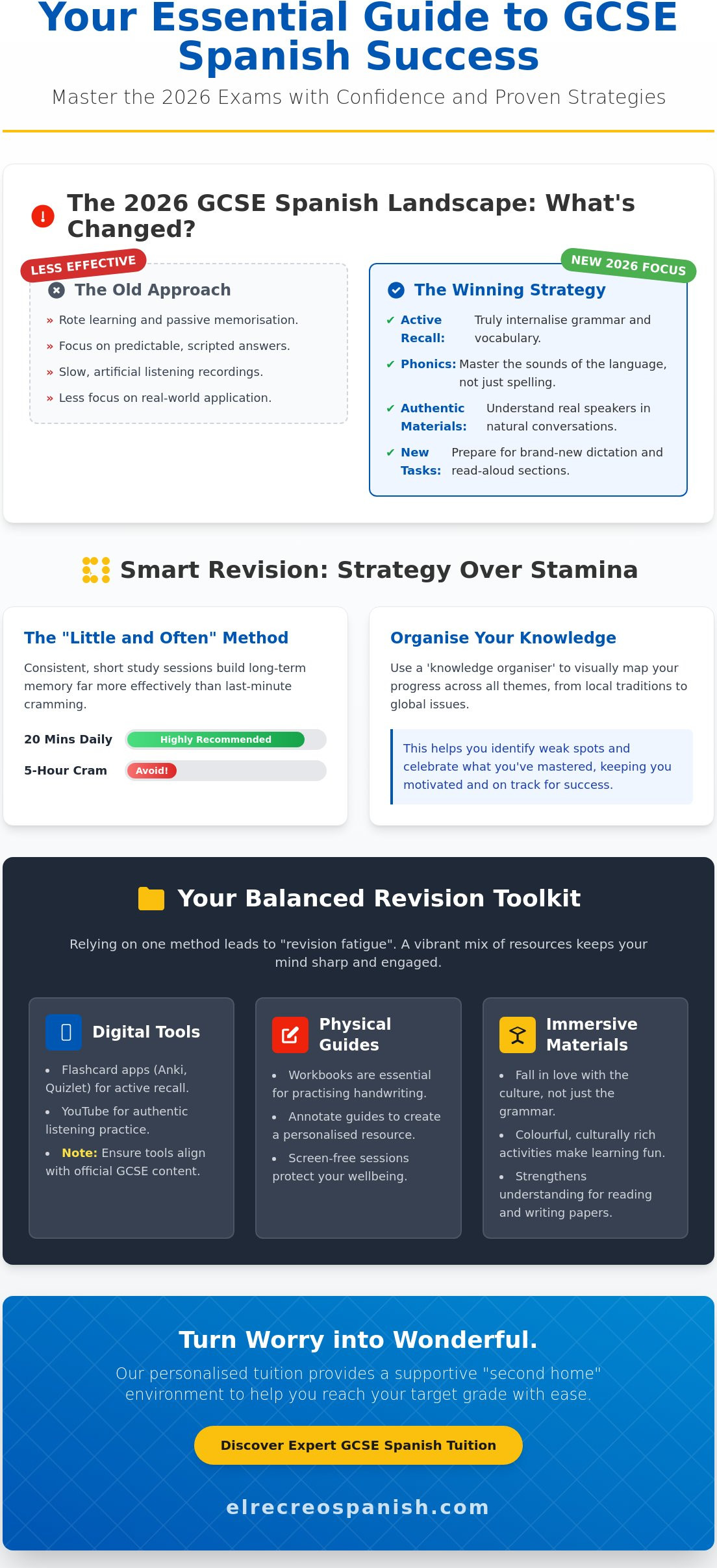
The General Certificate of Secondary Education (GCSE) has evolved to move away from predictable, scripted answers. Old-fashioned rote learning, where you simply stare at a page until the words stick, is becoming less effective for modern assessment styles. These new exams reward students who can handle spontaneous conversation and understand authentic Spanish voices. This is why "active revision" is now the gold standard for high-achieving students. Instead of passive reading, you'll be engaging with the language through sound, movement, and constant recall to build genuine confidence.
Key Changes in the 2026 Specifications
The 2026 specifications place a huge emphasis on high-frequency vocabulary and phonics. You'll need to master the sounds of the language just as much as the spelling! There’s also a clear shift towards more authentic listening and reading materials. This means you'll be hearing real Spanish speakers in natural settings rather than slow, artificial recordings. These changes impact the type of GCSE Spanish revision support you should seek. It's no longer enough to just know the words; you must understand how they sound in a fast-paced, real-life context.
Setting Realistic Revision Goals
Starting your journey early is the secret to success. A balanced schedule prevents that last-minute panic and keeps the learning process enjoyable! We recommend using a "knowledge organiser" to track your progress across different themes, from local traditions to global issues. This visual map helps you see exactly what you've mastered and what needs a bit more love. Remember, "little and often" is the magic formula for long-term retention. Spending 20 minutes every day engaging with Spanish is far better for your brain than a stressful five-hour cramming session on a Sunday evening!
Essential GCSE Spanish Revision Support Resources
¡Hola, amigos! Finding the right tools for your revision journey is like packing a suitcase for a grand adventure; you need a bit of everything to be prepared for any weather! Relying on just one textbook can lead to "revision fatigue," where your brain starts to switch off because things feel too repetitive. To keep your energy high and your mind sharp, it's vital to mix digital, physical, and interactive resources. This variety ensures that providing GCSE Spanish revision support stays vibrant, interaktív, and, most importantly, effective.
Digital Tools and Interactive Platforms
We're lucky to live in a world full of clever tech! Flashcard apps like Anki or Quizlet are fantastic for building vocabulary through active recall. They're perfect for those "little and often" moments we mentioned earlier. Whilst general language apps are a fun way to start, they don't always align with the specific criteria found in the official 2026 GCSE Spanish subject content. Use YouTube to find native speakers, but be careful not to fall down a rabbit hole of unrelated videos! Focus on channels that offer clear listening practice tailored to the new phonics requirements.
Physical Guides and Workbooks
There's something magical about picking up a real pen and paper. Physical workbooks are essential for the writing exam because they help you practise the actual skill of forming sentences by hand. You can't "click and drag" in the exam hall! We encourage you to annotate your revision guides with colourful highlighters and sticky notes. This turns a generic book into your own personalised "cheat sheet" of tricky phrases and grammar rules. Plus, having a few screen-free sessions every week is a wonderful way to protect your wellbeing and focus during a busy term.
El Recreo Educational Materials
At El Recreo, we believe that learning should always feel like a celebration. Our specially designed Spanish activities for kids are perfect for creating a less stressful, immersive environment at home. These resources aren't just about passing a test; they're about falling in love with the culture. By engaging with colourful, culturally rich materials, you'll find it much easier to tackle the reading and writing papers. When you understand the heart behind the language, the exams become a much more manageable kaland! If you're looking for extra inspiration, you can explore our Spanish classes for all ages to see how we bring the language to life.
Don't forget the power of "authentic" materials too. Listening to a short Spanish podcast or reading a snippet of news from a Spanish website makes the language feel alive. Combine these with regular practice using past papers to build that all-important exam-room familiarity. This balanced approach will ensure you walk into that hall feeling like a true Spanish pro!
Strategy Over Stamina: Mastering the Four Exam Papers
Revision isn't a marathon of suffering; it's a strategic game! To reach those top marks, you don't need to spend ten hours a day staring at a screen. You need a clever plan that targets the four distinct papers: Listening, Reading, Writing, and Speaking. Providing comprehensive GCSE Spanish revision support means looking at each paper as a unique challenge. Success comes from "Active Recall," which is the gold standard for high-achieving students. Instead of just reading a grammar rule, try to recreate it from memory. This strengthens your brain's pathways and makes the information stick when you're under pressure in the exam hall.
Memorising over 1,200 words might sound like a mountain to climb, but "Spaced Repetition" makes it a walk in the park! This technique involves reviewing vocabulary at increasing intervals. It ensures that the words you learn today stay in your long-term memory for next June. When exploring AQA GCSE Spanish resources, you'll notice the emphasis on clear, accurate communication. To achieve this, you need feedback. You simply cannot revise for the writing paper in a vacuum. You need a mentor or teacher to spot your grammar slips and help you polish your "flair."
Tackling the Listening and Reading Papers
Sneaky "distractors" are common in multiple-choice questions. These are options that look correct but contain a tiny detail that makes them wrong. To avoid these traps, use context clues. If you don't know a specific word, look at the sentences around it to guess the meaning. We love the "three-pass" method for reading complex texts. First, skim for the general vibe. Second, scan for key dates and names. Finally, do a deep dive to answer the specific questions. This structured approach keeps you calm and focused!
The Writing Paper: Accuracy and Flair
The writing paper is your chance to shine! To secure higher marks, you must show off a variety of tenses. Mixing past, present, and future in one paragraph proves you're a confident linguist. Adding "idiomatic expressions" is like adding extra spice to a meal; it makes everything better! Phrases like "ser pan comido" (to be a piece of cake) show the examiner you've moved beyond basic translation. Common pitfalls, like forgetting gender agreement or misplacing accents, can be avoided through regular, timed practice. This targeted GCSE Spanish revision support ensures you aren't just memorising, but actually communicating with confidence and style.
Overcoming Speaking Exam Anxiety
It's no secret that the speaking exam is the number one source of stress for almost every student. The thought of sitting across from an examiner can feel like a daunting performance, but it doesn't have to be that way! Real GCSE Spanish revision support focuses on turning that anxiety into a sense of vibrant excitement. At El Recreo, we believe that when the language feels alive and interaktív, the pressure of the exam room begins to melt away. Instead of a cold assessment, we frame the speaking window, which runs from 1 April to 20 May 2026, as a Spanish adventure where you finally get to show off your hard work.
The exam usually involves a role-play and a photo card task. Preparing for these requires more than just memorising scripts. You need to build the "muscle memory" of spontaneous conversation. In the role-play, you'll handle a specific scenario, like asking for directions or booking a holiday. The photo card asks you to describe an image and answer follow-up questions. Professional support helps you develop a toolkit of phrases that work in any situation, giving you the önbizalom to speak freely without fear of making a mistake. This approach ensures you're ready for anything the examiner throws your way.
Mock Exams and Real-Time Feedback
Practising with a native speaker or an expert tutor is truly irreplaceable. They can spot tiny pronunciation slips and help you find your natural rhythm. We always suggest recording your practice sessions! Listening back to yourself is a great way to self-assess your fluency and see where you might be hesitating. It's also vital to simulate exam conditions by using a timer. This helps you get used to the pace of the real thing, making the actual day feel like just another practice session amongst friends.
Managing Exam-Day Nerves
Those 12 minutes of preparation before you enter the room are precious. Use them to breathe deeply and shift your mindset from "I must be perfect" to "I am going to communicate." If you get stuck on a word, don't panic! Use "muletillas" or filler phrases like "pues" or "déjame pensar" to keep the conversation flowing. Examiners aren't looking for perfection; they're looking for communication and flair. Often, having the confidence to keep going is the difference between a Grade 6 and a Grade 8. If you want to build that unshakable confidence, explore our Spanish classes for all ages and start your journey today!
The El Recreo Advantage: Expert GCSE Spanish Tuition
¡Hola, amigos! At El Recreo, we believe that providing the right GCSE Spanish revision support is about more than just checking boxes; it's about creating a space where you feel safe to explore, make mistakes, and grow. Our school isn't a stiff, formal institution. Instead, we've built a "second home" for language learning where every student is treated with care and professional magabiztosság. Our founders, Paula and Maria, bring a wealth of expertise and passion to every session, ensuring that your journey towards the 2026 exams is filled with joy, music, and genuine progress.
Our sessions are designed to bridge the gap between standard school lessons and the high-level success you're aiming for. We know that the 2026 specifications require a deep understanding of phonics and high-frequency vocabulary. By working with experts who live and breathe the language, you'll find that these new challenges become exciting opportunities rather than stressful hurdles. We're here to help you turn your hard work into a vibrant celebration of your skills!
Private Tuition vs. Classroom Learning
Whilst classroom teachers do a fantastic job, 1-to-1 attention is a real game-changer for identifying specific grammatical weaknesses. In a large group, it's easy to hide behind others, but in our tailored sessions, we can zoom in on the exact areas where you need a boost. Whether you're following the AQA or Edexcel board, we ensure your practice is laser-focused on the criteria that matter most. We also know how hectic Year 11 can be! Our tuition offers the flexibility you need to fit around mock exams and coursework, providing a calm, steady anchor amongst the revision storm.
A Holistic Approach to Spanish
We look far beyond the final grade. Our goal is to foster a lifelong love for the Spanish language that stays with you long after the exam hall doors have closed. Many of our students begin their journey with Spanish for primary school children and stay with us all the way through to secondary school excellence. This long-term connection builds incredible önbizalom and a natural, fluid way of speaking.
Investing in GCSE Spanish tuition means you're giving yourself the gift of personalised, expert guidance. We'll help you create a structured schedule that actually works, turning your GCSE Spanish revision support into a truly magical kaland. Are you ready to reach your target grade with a smile? Let's get started on your personalised revision plan today!
Step Into Your Spanish Success Story
Your journey towards the 2026 exams is far more than just a test; it's a vibrant kaland waiting to happen! By embracing the new curriculum's focus on phonics and high-frequency vocabulary, you're setting yourself up for genuine, real-world fluency. We've explored how active strategies like spaced repetition and timed speaking practice are your best friends for building long-term memory and unshakable exam-day önbizalom. Success comes when you stop simply memorising and start truly communicating with the world around you.
Since 2013, El Recreo Spanish has provided a supportive "second home" for students across the UK. Our specialised GCSE preparation programmes, led by Spanish-speaking professionals, are designed to bridge the gap between school lessons and top-tier results. We use immersive techniques to make the language feel natural, interaktív, and exciting rather than stressful. If you're ready to transform your grades and find your authentic voice, book your expert GCSE Spanish revision support session with El Recreo Spanish today. We've been helping linguists thrive for over a decade, and we can't wait to see you shine. ¡Vamos, amigos! The world of Spanish is yours to discover!
Frequently Asked Questions
What is the best way to revise for GCSE Spanish?
The best way to revise is to move away from passive reading and embrace active recall techniques. This involves testing yourself regularly on grammar and vocabulary rather than just staring at a textbook. Spaced repetition is also vital; reviewing your notes at increasing intervals helps move information into your long-term memory. Mix up your methods with flashcards, past papers, and listening to Spanish music to keep things fresh and exciting!
How much vocabulary do I need for GCSE Spanish in 2026?
You need to master a specific list of high-frequency words, which usually totals at least 1,200 words for the 2026 exams. The new specifications focus heavily on these core words to ensure you can communicate effectively in real-life situations. Don't try to learn them all at once! Breaking the list down into small, manageable chunks of 10 to 15 words a day makes the task much more achievable and less daunting.
Can I get a Grade 9 in Spanish if I started late?
It's absolutely possible to achieve a Grade 9 even if you feel you've started your revision journey a bit late. Success depends on focusing your energy on high-impact strategies like mastering the most frequent verbs and practising past paper techniques. With dedicated GCSE Spanish revision support and a structured plan, you can close the gap quickly. Focus on your specific weaknesses first to see the biggest jump in your marks.
Is private GCSE Spanish tuition worth it?
Private tuition is incredibly valuable for students who want personalised feedback and a boost in confidence. Unlike a busy classroom, a private session allows you to focus entirely on your specific grammatical hurdles and speaking anxiety. It's an investment in your future that provides a safe space to practise and refine your skills. This tailored approach often leads to significant grade improvements and a much more relaxed exam season.
How do I improve my Spanish listening skills for the exam?
Improving your listening skills requires consistent exposure to native Spanish speakers in natural settings. Start by listening to short Spanish podcasts or news snippets for just ten minutes every day to get your ears used to the rhythm of the language. Focus on identifying key "anchor words" rather than trying to translate every single syllable. This builds the resilience you need for the new, more authentic exam recordings introduced in 2026.
What are the main differences between AQA and Edexcel Spanish?
The main differences lie in the specific themes covered and the layout of the exam papers. Whilst both boards test the same four skills, AQA might focus on different cultural topics compared to Edexcel. The 2026 updates have brought them closer together with a shared focus on phonics and dictation. It's vital to use GCSE Spanish revision support that is tailored to your specific board to ensure you're familiar with their unique question styles.
How can I practise for the Spanish speaking exam at home?
Practising at home is easy if you use your phone to record yourself answering common exam questions. Listen back to check your pronunciation and see where you can add more "flair" with idiomatic expressions. You can also narrate your daily activities in Spanish to build spontaneous speaking habits. Don't be afraid to talk to your pets or even yourself in the mirror; it's all about building that vocal confidence before the big day!
What resources do El Recreo Spanish offer for GCSE students?
El Recreo Spanish offers a wonderful range of support, including private tuition, specialised GCSE preparation programmes, and immersive activities. We specialise in making the language feel vibrant and accessible through our unique play-based philosophy. Our sessions are specifically tailored to the 2026 requirements, providing the expert guidance you need to succeed. We focus on building genuine fluency and a lifelong love for the Spanish-speaking world in a supportive environment.