

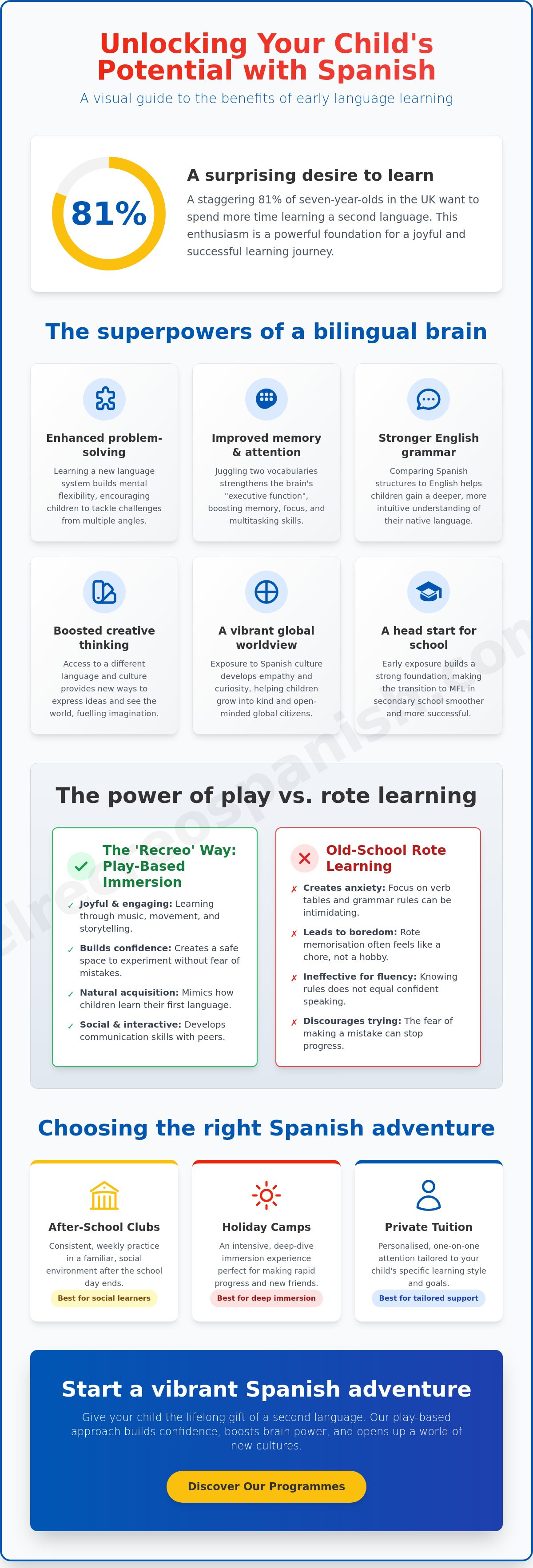
Did you know that a staggering 81% of seven-year-olds in the UK actually want to spend more time learning a second language? It is a heart-warming statistic, yet for many parents, the reality feels a bit different. You might worry about adding more "work" to an already busy school week, especially if you don't speak a word of the language yourself. Finding the right approach to Spanish for primary school children shouldn't feel like another chore on the to-do list.
We agree that children are at their best when they are having fun, not just memorising lists of verbs. Our "learning through play" philosophy ensures that every session feels like a recreo, a joyful break filled with music, movement, and laughter. We promise to show you how to transform language learning into a vibrant adventure that boosts your child’s confidence and academic success. This guide explores the magic of immersive learning and provides practical ways to make Spanish your child's favourite new hobby. ¡Hola, amigos!
Key Takeaways
- Discover how early language learning sharpens problem-solving skills and provides a vital foundation for understanding English grammar.
- Learn why a play-based immersion approach is the most effective way to teach Spanish for primary school children, turning lessons into a "recreo" adventure.
- Find out how to choose between after-school clubs, holiday camps, and private tuition based on your child's unique personality and schedule.
- Uncover simple, stress-free ways to integrate Spanish into your daily home routine, even if you don't speak the language yourself.
- See how a caring, child-centred environment builds genuine confidence and a lifelong love for exploring new cultures.
The Cognitive and Academic Benefits of Spanish for Primary School Children
The brain is like a muscle, and learning a second language is the ultimate workout! When we introduce Spanish for primary school children, we aren't just teaching them how to say "apple" or "dog". We're actually helping their young minds build complex neural pathways. Research shows that early language learning enhances problem-solving skills and creative thinking. It encourages children to look at challenges from different angles, which is a magical skill to have in any classroom environment.
As they learn to navigate Spanish, children often find that their understanding of English grammar improves too. They begin to compare linguistic structures, noticing how verbs and nouns work together. This boosts their native-language literacy and turns them into more attentive listeners. It’s a vibrant adventure that makes them better communicators in every sense!
It isn't just about the words; it's about the people! Exposure to Spanish culture helps children develop deep empathy and a vibrant, global worldview. They learn to appreciate different ways of life from an early age, which is essential for growing into a kind and curious adult. ¡Hola, future global citizens!
Boosting Brain Power and Memory
Bilingualism does wonders for a child's "executive function". This is the part of the brain that manages attention, memory, and self-control. There are significant cognitive benefits of learning a second language, including a much stronger attention span. Because their brains are constantly switching between two sets of vocabulary, bilingual children often develop superior multitasking abilities.
The primary school years are often called the "golden window" for language acquisition. This is due to the critical period hypothesis; it suggests that younger children are naturally wired to pick up phonics and native-like accents. At this age, their ears are incredibly sensitive to new sounds. This makes it the perfect time to start their Spanish journey and build lasting memory skills through play.
A Head Start for Secondary School
Think of early Spanish lessons as a springboard for the future. When children move into Year 7, the transition to Modern Foreign Languages (MFL) becomes so much smoother. They already have the confidence to speak up and a natural "ear" for romance languages. Early exposure to Spanish for primary school children builds the self-belief needed to tackle GCSE Spanish later on with a smile on their face.
Beyond the classroom, being a Spanish speaker opens up a world of vibrant travel and social connections. Whether they are making new amigos on holiday—perhaps while staying at a Spanish-inspired retreat like Solana Spanish Villas—or looking at global career paths in the future, these skills are a gift that lasts a lifetime. It turns language learning into a social hobby that brings joy long after the school bell rings.
Moving Beyond Rote Learning: The Power of Play-Based Immersion
Immersion is a word that gets tossed around a lot, but what does it actually look like for a seven or eight-year-old? It isn't about sitting in a silent room listening to audio tapes. True immersion means surrounding a child with the language through multi-sensory activities. It's about what they can see, touch, hear, and do. When we teach Spanish for primary school children, we transform the room into a vibrant space where every sense is engaged. It's interactive. It's loud. It's wonderful!
We believe that "Recreo" (playtime) is the most effective way for children to internalise new sounds. Think about how children learn their first language; they don't start with grammar books. They learn through trial, error, and joy. By using music, movement, and storytelling, we create a "magical" atmosphere. Rhythm helps vocabulary stick, whilst physical movement creates muscle memory for new phrases. This social interaction with peers accelerates speaking confidence far faster than any solo digital app ever could. Children need to see the sparkle in a friend's eye when they finally understand a joke in Spanish.
Why Traditional Methods Often Fail Young Learners
Traditional schooling often leans too heavily on translation and complex verb tables far too early. This can lead to "language anxiety", where a child becomes so afraid of making a mistake that they stop trying altogether. We want to avoid that at all costs. Recent research on bilingual children suggests that natural acquisition is much more powerful than rote memorisation. By making Spanish a favourite hobby rather than a school subject, we keep the pressure off and the excitement high. If you want to see your child flourish, our After School Clubs provide the perfect environment for this natural growth.
Creating a Vibrant "Spanish Only" Environment
Hearing native-level pronunciation is vital. In our caring and supportive centres, children are exposed to the authentic lilt and rhythm of the language. We use visual cues, colourful props, and expressive gestures to help children understand what's happening without needing to translate every word into English. This reduces frustration and keeps the "Spanish adventure" moving forward. When a child uses Spanish to complete a fun task, like finding a hidden treasure or winning a game, they aren't just "learning" anymore. They are communicating. That is where genuine fluency begins.
Finding the Right Fit: After-School Clubs, Holiday Camps, and Private Tuition
Every child has a unique spark. Some children are social butterflies who thrive in a crowd, whilst others prefer a quiet, focused environment to find their feet. When you are looking into Spanish for primary school children, it's vital to evaluate your child’s personality and your family’s busy schedule. The right format can be the difference between a child who feels overwhelmed and one who can't wait for their next "Spanish adventure".
Consistency is the secret ingredient to success. After-school clubs provide that regular, weekly reinforcement that helps build long-term habits. It keeps the sounds of the language fresh in their minds without feeling like extra "homework". On the other hand, holiday camps offer a burst of intensive immersion that often leads to rapid "breakthrough" moments. For those who need a bespoke pace, perhaps to catch up or prepare for future challenges like GCSE Spanish, private tuition offers a tailored approach that builds genuine confidence.
The Social Benefits of Spanish After-School Clubs
Our after-school clubs are about so much more than just vocabulary. They are vibrant social hubs where children make new amigos whilst learning a shared skill. We use collaborative games to build teamwork. This social interaction is key. It removes the pressure of "performing" and replaces it with the joy of communicating with peers. A regular weekly session ensures the language stays "fresh" and becomes a natural part of their routine. It's a social hobby that grows with them!
Spanish Holiday Camps: A Deep Dive into Culture
Imagine a "Spanish holiday" without ever leaving the UK! Our holiday camps are a deep dive into the heart of Hispanic culture. We don't just speak the language; we live it through crafts, cooking, and traditional games. A full week of immersion significantly boosts a child’s listening comprehension. They stop translating in their heads and start responding naturally to the rhythm of the speech. It's a magical experience that turns a school break into a voyage of discovery. These camps are perfect for sparking a lifelong passion for travel and global empathy.
Whether you choose the steady rhythm of a club or the exciting splash of a camp, the goal is the same. We want your child to feel proud of their progress. By choosing the format that fits their life, you're giving them a gift that opens doors across the globe. It's about building a foundation of self-belief that will serve them in Year 7 and far beyond!
How to Support Your Child’s Spanish Journey at Home
You don't need to be a fluent speaker to nurture a love for Spanish for primary school children at home. In fact, many of our most successful students come from families where English is the only language spoken! The secret isn't in perfect grammar; it's in showing your child that exploring a new culture is a vibrant adventure you can share together. By making the language a natural part of your home life, you help turn those weekly lessons into a lasting, social hobby.
Integrating Spanish into your daily routine is easier than you think. Try adding simple labels to household items, such as la mesa for the table or la silla for a chair. You can use common phrases like "¡Hola!" in the morning or "Gracias" at dinner time. These small moments build a bridge between their classes and their "real world", showing them that Spanish is a living, breathing tool for communication. It builds enormous confidence when they realise they can use their new skills outside of a classroom setting.
Using Spanish Books and Activities
Bedtime stories offer a magical opportunity to introduce bilingualism. We highly recommend books where English and Spanish text appear side-by-side. This allows you to follow the story together whilst your child begins to recognise familiar words in a new context. On rainy weekends, Spanish activity books are a lifesaver. They keep learning fun through puzzles and colouring, ensuring the language remains an exciting game rather than a chore. Our Spanish books for kids are carefully curated to introduce new vocabulary through engaging stories and colourful illustrations that spark the imagination.
Digital Resources and Audio
Audio is a powerful tool for developing a natural accent and rhythm. Try playing catchy Spanish songs in the car on the way to school. You don't need to understand every word to enjoy the beat, and children are incredibly talented at picking up the lilt of the language through music. You can even set a "Spanish hour" at home for interactive play or games. If you are feeling unsure about your own skills, our resources are designed to help you learn along with your child. To get started today, why not explore our ebook for parents raising bilingual kids and discover how to make this journey a joyful success for the whole family?
By creating this supportive environment, you are telling your child that their hard work is valued. You are building their self-belief and showing them that being a Spanish speaker is a badge of honour. Whether it's through a song, a label, or a story, every little bit of Spanish at home makes their academic journey smoother and more rewarding. ¡Vamos, amigos!
Discovering a Vibrant Spanish Adventure with El Recreo Spanish
Paula and Maria founded El Recreo Spanish with a simple, heart-felt mission: to share the vibrant beauty of their native language and culture with the next generation. They didn't want to create just another rigid, dusty classroom. Instead, they envisioned a "second home" where children could flourish. Today, our national network of clubs and camps brings this vision to life across the UK. We provide a supportive, caring environment for Spanish for primary school children, ensuring every child feels seen, heard, and celebrated as they embark on their bilingual journey.
Our commitment goes beyond just one age group. We are here to support the whole family at every stage of childhood development. Whether you have a tiny explorer in our Spanish for Babies & Toddlers sessions or a teenager needing focused support for GCSE Spanish, we provide a consistent path to success. It is a holistic approach that builds genuine, lasting confidence. We believe that by nurturing a child's love for language early on, we are giving them a gift that opens doors across the globe. ¡Qué fantástico!
Our Play-Based Philosophy in Action
At the heart of everything we do is our "Learning through Play" model. This isn't just a catchy phrase; it is the centre of our entire curriculum. We believe that when children are laughing, moving, and creating, they are learning at their very best. Our range of After School Clubs and Holiday Camps across the UK are designed to be the highlight of your child's week. We celebrate every small win, from the first time they shyly say "¡Hola!" to the moment they confidently lead a game in Spanish. This caring approach ensures that progress feels like a personal victory, never a test.
Join the El Recreo Community
Starting your child's journey with us is easy. We invite you to join our growing community of families who value global empathy, cognitive growth, and the simple joy of discovery. Our programmes for Spanish for primary school children are designed to fit into your busy life whilst providing high-quality, immersive education. For those who share our passion for teaching and want to bring this magic to their own local area, we also offer a vibrant Franchise Opportunity. We provide the training and the tools; you provide the heart and the energy!
Are you ready to see your child's eyes light up with the joy of a second language? Enrol your child in a Spanish adventure today and watch their confidence soar to new heights. We can't wait to welcome you to our family. ¡Hasta pronto, amigos!
Start Your Child’s Vibrant Spanish Adventure Today
Choosing Spanish for primary school children is about more than just academic success; it is about opening a door to a world of vibrant culture and lifelong self-belief. We have explored how play-based immersion turns learning into a joyful "recreo", building brain power whilst making new amigos. Whether through a consistent weekly club or an intensive holiday camp, your child gains the confidence to thrive in Year 7 and far beyond. It is a gift that provides a head start in a globalised world.
El Recreo Spanish was founded in 2013 by Spanish-speaking mothers who wanted to share the magic of their heritage. Since then, our award-winning immersive teaching methods have helped children across the UK discover the joy of bilingualism. With our national coverage, a caring and professional mentor is always ready to guide your family’s journey. We provide a supportive community that feels like a second home, where every child’s progress is celebrated with energy and love.
Ready to take the first step? Find your nearest Spanish after-school club or holiday camp and let the discovery begin. We can't wait to see your child flourish and find their voice in Spanish. ¡Hasta pronto!
Frequently Asked Questions
At what age should my child start learning Spanish?
Children can start as early as birth, but the primary years are a magical "golden window" for language acquisition. At this age, their brains are naturally wired to pick up new phonics and native-like accents with incredible ease. Starting Spanish for primary school children early builds a strong foundation for future academic success and long-term cognitive development.
What if I do not speak any Spanish at home?
You don't need to speak a word of Spanish to support your child's bilingual journey. Many parents in our community are beginners themselves! You can use our bilingual books, play Spanish songs in the car, or use simple labels around the house. It's about showing curiosity and making the "Spanish adventure" a shared family experience that builds your own confidence too.
How long does it take for a primary school child to become fluent in Spanish?
Fluency is a long-term journey rather than a race, and every child progresses at their own unique pace. Consistency is the most important factor for success. By attending regular weekly sessions and engaging with the language at home, children often begin to understand and respond naturally within a few terms. Our focus is always on building the confidence to speak without fear.
Are Spanish after-school clubs better than online apps?
After-school clubs offer a vibrant social environment that digital apps simply cannot replicate. Whilst apps are useful for quick vocabulary drills, they lack the physical movement, peer interaction, and emotional connection of a live class. Children internalise language best when they are playing games and laughing with their amigos in a real-world, caring setting.
Will learning Spanish at a young age confuse my child with their English?
Learning a second language won't confuse your child; it actually makes them better at English! Research shows that bilingual children often have a deeper understanding of grammar and a wider vocabulary in their native tongue. It sharpens their brain's attention span, helping them focus better on all their school subjects and problem-solving tasks.
What happens in a typical El Recreo Spanish lesson?
A typical session is a high-energy "recreo" filled with music, storytelling, and movement. We don't sit at desks with dusty textbooks. Instead, children might be hunting for "treasure", singing traditional songs, or acting out an exciting story. Every activity is designed to be immersive and fun, ensuring they learn Spanish for primary school children without even realising they're working.
Do you provide support for children taking GCSE Spanish later on?
We certainly provide support for older students, including those preparing for GCSE Spanish. Our private tuition is tailored to the specific needs of the student, whether they need to catch up on grammar or build speaking confidence. The strong foundation built during their primary years makes this transition much smoother and significantly less stressful when the time comes.
How can I find a Spanish holiday camp during the school breaks?
You can find our upcoming holiday camps by visiting our website and checking our national location list. We run these immersive camps during most school breaks across the UK. They're a fantastic way for children to have a "Spanish holiday" close to home, filled with crafts, cooking, and traditional games that bring the vibrant culture to life.